
20th Aug 2026
The History of Jeeps: From American Bantam to the Modern Wrangler
Quick Facts
- Origin period: The Jeep story begins with the U.S. Army's 1940 search for a light four-wheel-drive reconnaissance vehicle.
- Key early companies: American Bantam, Willys-Overland, and Ford each played a key role in the vehicle's early development and wartime production.
- Best-known wartime models: The Willys MB and Ford GPW became the military vehicles most closely associated with the original Jeep image.
- Civilian transition: The CJ, or Civilian Jeep, line carried the wartime concept into farms, work sites, rural transportation, and recreational use.
- First major civilian model: The CJ-2A entered production in 1945 and helped establish Jeep as a civilian vehicle.
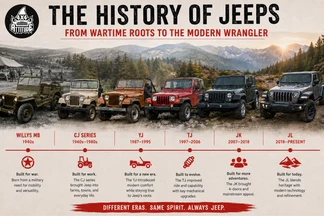
- Wrangler generations: YJ (1987-1995), TJ (1997-2006), JK (2007-2018), and JL (2018-present).
- Long-wheelbase TJ: Jeep enthusiasts commonly refer to the 2004-2006 Wrangler Unlimited as the LJ.
- Important overlap year: Both JK and JL Wranglers were sold for the 2018 model year.
- Name origin: The exact origin of the word "Jeep" remains disputed, with several explanations still discussed by historians.
Jeep History Begins With a Military Requirement
Jeep's history begins decades before the modern Wrangler became one of the world's most recognizable off-road vehicles. Its origins trace to 1940, when the U.S. Army sought a small, light four-wheel-drive reconnaissance vehicle that could operate across rough terrain while performing a wide range of military duties. The Army's requirements emphasized mobility, durability, compact dimensions, and practical usefulness. The resulting program attracted several manufacturers and produced the early vehicles that eventually developed into the standardized wartime Jeep. That military beginning is important because many traits still associated with Jeep were established long before the vehicle became a recreational or lifestyle product. Compact proportions, short overhangs, four-wheel-drive capability, simple construction, and adaptability were practical engineering choices before they became recognizable elements of Jeep identity. The earliest Jeep-type vehicles were built to solve a specific mobility problem. Their later cultural significance grew because the basic idea proved useful well beyond its original purpose.
American Bantam, Willys-Overland, and Ford All Belong in the Jeep Origin Story
The early history of Jeep cannot be accurately credited to a single manufacturer. American Bantam played a critical role during the earliest phase of the U.S. Army's light reconnaissance vehicle program. The company developed and delivered an early prototype in 1940, helping establish the basic concept that would continue through later testing and development. Willys-Overland and Ford also submitted vehicles for evaluation as the Army refined its requirements. Willys-Overland eventually received a major production contract in 1941, while Ford later joined large-scale production to help meet wartime demand. The standardized vehicles produced by Willys and Ford became known primarily as the Willys MB and the Ford GPW. Each company therefore contributed to a different part of the story. American Bantam was central to the early prototype phase. Willys-Overland became strongly associated with the standardized production design, and Ford provided enormous manufacturing capacity during World War II. Jeep history is best understood as a development process shaped by military requirements, competing prototypes, engineering changes, and large-scale wartime production rather than the work of a single company acting alone.
The Willys MB and Ford GPW Defined the Wartime Jeep
The Willys MB and Ford GPW became the vehicles most strongly associated with the Jeep name during World War II. Although different manufacturers produced them, the two models were built around a highly standardized design so parts and components could remain largely interchangeable in military service. Their compact size, four-wheel-drive systems, simple bodies, and practical layouts allowed them to perform a wide variety of jobs. Wartime Jeeps served in transportation, reconnaissance, communications, supply movement, field support, and other duties. Their ability to operate in difficult terrain while remaining relatively small and maneuverable made them valuable in environments where larger vehicles were less practical. The Jeep's reputation therefore developed through use rather than appearance alone. It became associated with versatility because the vehicle could perform many tasks rather than being limited to a single purpose. That reputation survived the war and became a foundation of Jeep's later civilian identity.
Where Did the Name "Jeep" Come From?
The origin of the word "Jeep" remains one of the most debated parts of the vehicle's history. One familiar explanation connects the name to the letters "GP." This theory is sometimes described as a shortened pronunciation related to "general purpose," although historians have questioned whether that explanation fully accounts for how the name developed. Another theory points to military slang that predates the wartime vehicle's fame. The word "jeep" reportedly referred to an untested recruit, an unfamiliar piece of equipment, or an unusual machine in some contexts. Popular culture may also have helped spread the name. Eugene the Jeep, a fictional character from the Popeye comics, appeared before World War II and was known for traveling almost anywhere. That association made the character an appealing comparison once the military vehicle gained a similar reputation for mobility. No single theory has completely displaced the others. The safest historical conclusion is that the exact origin of the Jeep name remains disputed. What is clear is that the term became closely associated with the military vehicle during the war and eventually developed into one of the most recognizable automotive names in the world.
The CJ-2A Brought the Jeep Concept Into Civilian Life
The end of World War II did not mark the end of the Jeep story. Willys-Overland recognized that the small four-wheel-drive vehicle could have significant value outside military service. The result was the CJ, or Civilian Jeep, line. The CJ-2A entered production in 1945 and became the first major civilian version of the Jeep concept. Although it retained the basic layout and rugged character of the wartime vehicles, it included changes intended for civilian work. The CJ-2A was marketed for agricultural, industrial, construction, transportation, and other utility applications. Features such as a tailgate and side-mounted spare tire reflected the different needs of civilian owners. This transition was one of the most important moments in Jeep history. The wartime Jeep had proven that a compact four-wheel-drive vehicle could operate effectively in demanding conditions. The CJ-2A demonstrated that the same basic formula could also work on farms, ranches, job sites, rural roads, and recreational property. That civilian transition allowed Jeep to develop into a long-term vehicle family rather than remain primarily a symbol of World War II.
The Early CJ Models Continued to Develop the Civilian Formula
Several CJ generations followed the CJ-2A as manufacturers continued refining the civilian Jeep.
CJ-2A: 1945-1949
The CJ-2A established the postwar civilian Jeep market. Its design remained closely connected to wartime vehicles, but civilian-oriented changes made it better suited to farm, industrial, and utility work.
CJ-3A: 1949-1953
The CJ-3A continued the basic formula while introducing several practical refinements. It retained the compact dimensions and simple construction that had already become central to the Jeep identity.
CJ-3B: 1953-1968
Its taller hood and grille area make the CJ-3 B easy to recognize. Those changes added engine clearance and gave the model a distinct look while keeping the traditional short-wheelbase Jeep layout.
Together, these early CJ models helped establish that Jeep could survive beyond its military origins as a practical civilian four-wheel-drive vehicle.
The CJ-5 Became One of the Longest-Running Civilian Jeeps
The CJ-5 entered production in the 1950s and became one of the most significant vehicles in Jeep history. Produced from 1955 through 1983, the CJ-5 remained in the lineup for nearly three decades. Its long production run shows how durable the basic Jeep formula had become in the civilian market. The CJ-5 continued to serve utility buyers, but recreational off-road use became increasingly important during its lifespan. Owners used Jeeps for hunting, camping, trail driving, property work, outdoor recreation, and everyday transportation. The related CJ-6 used a longer wheelbase to provide additional cargo space while retaining much of the same basic design philosophy. During this era, Jeep increasingly became more than a work vehicle. It was also developing into a recreational platform. That shift became even more important during the CJ-7 and later Wrangler generations.
The CJ-7 and CJ-8 Expanded What a Civilian Jeep Could Be
The CJ-7 arrived for the 1976 model year and remained in production through 1986. Compared with the CJ-5, the CJ-7 used a longer wheelbase and offered greater interior space. The model helped make Jeep more practical for owners who wanted traditional off-road capability without the tighter dimensions of earlier CJs. The CJ-7 became one of the best-known civilian Jeep models and served as the direct predecessor to the first Wrangler. The CJ-8 Scrambler followed in the early 1980s. Produced from 1981 through 1985, it used an extended wheelbase and pickup-style configuration that made it visually and functionally different from most earlier CJs. These later CJs showed how the Jeep platform could change in size and purpose without losing its basic identity. They also helped establish an important pattern that would continue into the Wrangler era: owners increasingly expected a Jeep to combine utility, recreation, customization, and everyday usability.
The CJ Era Helped Turn Jeep Into a Lifestyle Vehicle
The CJ years did more than establish a long sequence of civilian model codes. They also changed how people used and viewed Jeeps. Early civilian models were promoted heavily for farming, industrial work, and rural transportation. Over time, recreational driving became increasingly important. Jeeps were used for camping, hunting, trail exploration, beach driving, outdoor recreation, and four-wheeling. This transition helped move Jeep from primarily a utility vehicle to one associated with an outdoor lifestyle and personal identity. Customization also became increasingly connected to Jeep ownership. Owners changed tires, suspension components, tops, bumpers, recovery equipment, lighting, and other parts to suit the environments in which they drove. The modern Jeep aftermarket did not appear overnight. It grew out of decades of owners adapting simple, flexible vehicles for specific jobs and recreational uses. That culture of modification would become even more visible after the Wrangler replaced the CJ.
The Wrangler YJ Began the Modern Wrangler Era
The Wrangler YJ arrived for the 1987 model year and remained in production through 1995. It replaced the CJ-7 and formally introduced the Wrangler name. The YJ preserved many recognizable Jeep characteristics, including a removable top, a short wheelbase, an open body design, and strong off-road capability. At the same time, Jeep sought to improve comfort, handling, stability, and everyday drivability. One of the YJ's most recognizable features was its rectangular headlights, which sharply distinguished it from earlier CJ models. The YJ also used a wider track than its predecessor and represented an effort to make the Jeep formula better suited to buyers who wanted both off-road ability and improved road manners. Historically, the YJ matters because it established the structure Jeep still uses today. Instead of continuing the CJ naming sequence, Jeep moved into distinct Wrangler generations identified by internal platform codes. The Wrangler era had begun.
The Wrangler TJ Brought Back Round Headlights and Added Coil Springs
The Wrangler TJ arrived for the 1997 model year and remained in production through 2006. Visually, one of its most noticeable changes was the return of round headlights, reconnecting the Wrangler's appearance to earlier CJ and military-era designs. The larger mechanical change was underneath the vehicle. The TJ replaced the YJ's leaf-spring suspension with a four-link coil-spring design. That change significantly improved wheel articulation and ride quality while preserving the solid-axle layout associated with traditional Jeep off-road capability. The TJ therefore combined several themes that would become important to later Wranglers. It modernized ride and suspension behavior without eliminating the basic mechanical layout or recognizable styling cues that connected it to earlier Jeeps. The TJ era also expanded the Wrangler lineup through a longer-wheelbase version that arrived near the end of the generation.
The 2004-2006 Wrangler Unlimited Is Commonly Known as the LJ
In 2004, Jeep introduced a longer-wheelbase Wrangler Unlimited based on the TJ generation. Enthusiasts commonly refer to this model as the LJ, although Wrangler Unlimited was the official model name. The longer wheelbase created additional passenger and cargo room while preserving the general TJ layout and appearance. This gave buyers a Wrangler that was more practical for carrying gear or for traveling longer distances without having to switch to an entirely different type of vehicle. The LJ was offered from 2004 through 2006 and has since become one of the most recognizable variations of the TJ platform.
Its historical importance goes beyond production volume. The LJ demonstrated that Wrangler dimensions could grow to serve buyers who needed more space without abandoning the core Wrangler design. That idea became even more significant with the next generation.
The Wrangler JK Changed the Market With a Four-Door Model
The Wrangler JK debuted for the 2007 model year and remained in production through 2018. It represented one of the most important expansions in Wrangler history. The biggest change was adding a four-door Wrangler Unlimited. Earlier Jeeps had experimented with longer wheelbases and expanded interior space, but the JK made the four-door Wrangler a major part of the mainstream lineup. That configuration changed who could realistically consider owning a Wrangler. Four doors, increased passenger space, and additional cargo capacity made the vehicle more practical for families, commuters, road-trippers, and owners who needed one vehicle to serve multiple purposes. At the same time, the JK retained many traditional Wrangler characteristics, including body-on-frame construction, solid axles, removable tops, removable doors, and dedicated four-wheel-drive systems. The JK helped expand Wrangler ownership beyond the traditional two-door enthusiast market without completely separating the vehicle from its off-road roots. Its success also helped establish the four-door Wrangler as a central part of the model line rather than a temporary variation.
The Wrangler JL Modernized the Formula Without Replacing It
The Wrangler JL arrived for the 2018 model year and remains the current Wrangler generation. Like previous generations, the JL represents evolution rather than complete reinvention. It retains several structural and visual traits closely associated with Wrangler history. These include body-on-frame construction, solid front and rear axles, removable doors, removable or retractable roof options, upright proportions, and dedicated four-wheel-drive systems. At the same time, the JL introduced improvements intended to meet modern expectations for daily transportation. Changes in technology, infotainment, interior design, safety features, powertrain availability, and overall refinement made the Wrangler more comfortable and usable for everyday driving than earlier generations. The JL demonstrates one of the longest-running patterns in Jeep history. Major changes are introduced gradually, while enough familiar characteristics remain that each new Wrangler still has a clear visual and mechanical connection to the vehicles that came before it.
Why 2018 Can Be Confusing for Wrangler Owners
The 2018 model year deserves special attention because both JK and JL Wranglers were sold under the same model-year designation. That overlap can confuse owners researching parts, accessories, replacement components, or vehicle specifications. A 2018 Wrangler is not automatically a JL. Late-production JK models were still available alongside the newly introduced JL, so owners need to identify the actual generation rather than relying on the model year alone. This distinction matters because many vehicle-specific components differ between the JK and JL platforms. It's also a useful example of how automotive history doesn't always divide cleanly at the start of a calendar or model year. Production changes, outgoing models, and newly introduced platforms can overlap. For Jeep owners, 2018 remains one of the most important model years to verify carefully.
How Modification Became Part of Jeep Culture
Modification has been connected to Jeep ownership for much of the vehicle's history. The military adapted Jeeps for specific duties. Early civilian Jeeps could be equipped for agricultural, industrial, transportation, and property maintenance work. Recreational owners later modified their vehicles for trail driving, camping, hunting, and outdoor exploration. As Wrangler ownership expanded, the aftermarket grew. Suspension systems, wheels, tires, bumpers, recovery equipment, lighting, tops, body protection, storage systems, and comfort accessories allowed owners to adapt Jeeps to specific uses. That flexibility helps explain why customization remains so strongly associated with Jeep culture. A Wrangler can function as a daily commuter, trail vehicle, family SUV, camping platform, recreational four-wheeler, or a combination of several roles. Modifying a Jeep is therefore not separate from the vehicle's history. It follows an older pattern of adapting a simple, capable platform to the job or environment in which it will be used.
Jeep History Timeline
- 1940: The U.S. Army seeks a light four-wheel-drive reconnaissance vehicle.
- 1940: American Bantam develops and delivers an early prototype.
- 1941: Willys-Overland becomes a major producer of the standardized military vehicle.
- World War II: Willys MB and Ford GPW models became the vehicles most strongly associated with the wartime Jeep.
- 1945-1949: The CJ-2A establishes Jeep's major transition into civilian use.
- 1949-1953: The CJ-3A continues the development of the early civilian platform.
- 1953-1968: The CJ-3B introduces the distinctive high-hood design.
- 1955-1983: The CJ-5 becomes one of Jeep's longest-running civilian models.
- 1976-1986: The CJ-7 expands interior space and becomes the direct predecessor to the Wrangler.
- 1981-1985: The CJ-8 Scrambler adds an extended, pickup-style variation to the CJ family.
- 1987-1995: The Wrangler YJ marks the beginning of the modern Wrangler era.
- 1997-2006: Wrangler TJ returns to round headlights and introduces coil-spring suspension.
- 2004-2006: Wrangler Unlimited, commonly called the LJ, extends the TJ wheelbase and adds usable interior space.
- 2007-2018: Wrangler JK brings the four-door Unlimited into the mainstream Wrangler lineup.
- 2018-present: Wrangler JL modernizes the platform while retaining traditional Wrangler architecture.
- 2018: JK and JL models overlap during the same model year.
Jeep History Shows a Consistent Pattern of Utility, Adaptation, and Identity
Jeep's history spans military reconnaissance vehicles, civilian work machines, recreational off-roaders, and modern SUVs. The names, manufacturers, technologies, and generations have changed, but the larger pattern has remained remarkably consistent. The earliest Jeep-type vehicles were developed because the military needed compact transportation that could operate in difficult terrain. The CJ line carried that practical formula into civilian life, where Jeeps became valuable for agriculture, industry, rural transportation, and recreation. The Wrangler era added greater comfort, technology, passenger space, and everyday usability while preserving many of the characteristics that made earlier Jeeps recognizable. The YJ established the Wrangler name. The TJ modernized the suspension while reconnecting the vehicle visually to earlier Jeeps. The JK dramatically expanded Wrangler ownership through the four-door Unlimited. The JL refined the platform again for modern drivers while maintaining the open-air design and off-road architecture associated with the model. Over more than eight decades of development, Jeep has repeatedly evolved to meet new expectations without abandoning the qualities that defined its earliest vehicles. That continuity is what connects American Bantam's early prototype, the Willys MB and Ford GPW, the civilian CJ series, and today's Wrangler. Each represents a different period, but together they form one of the most recognizable evolutionary lines in automotive history.