
1st Sep 2026
Ford Bronco Trail Essentials: What to Bring Off Road
A Better Bronco Trail Day Starts Before You Leave the Driveway
Most difficult trail days do not begin with one dramatic mistake. They begin with a forgotten water bottle, an uncharged radio, a missing tire gauge, or gear that does not fit the vehicle.
The best Ford Bronco trail essentials list isn't the longest. It is the checklist that covers safety, communication, tire care, recovery, comfort, visibility, and vehicle protection without filling every inch of cargo space.
Your final list should reflect the terrain, weather, trip length, and your group's experience. A maintained forest road requires different preparation than a sandy, rocky, muddy, or remote trail with limited cell service.
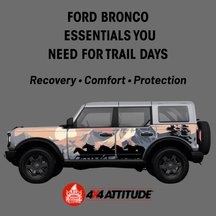
Start with safety and recovery equipment. Then add Bronco accessories that make the trip more comfortable and help protect the vehicle. Our Bronco 2-door sunshades, Bronco 4-door sunshades, 2-door Action Shield™ body armor, and 4-door Action Shield™ body armor support that second part of the checklist.
Quick Ford Bronco Trail Essentials Checklist
| Category | What to Pack | Why It Matters |
|---|---|---|
| Water and food | Drinking water, extra water, snacks, and meals when needed | Helps cover delays, heat, and longer trips |
| First aid | Complete first-aid kit and personal medications | Provides basic supplies when help is not nearby |
| Navigation | Offline maps, trail map, GPS device, and route information | Keeps the route available when cell service disappears |
| Communication | Charged phone, portable battery, and compatible group radio | Helps the group communicate during stops or separation |
| Tire care | Tire gauge, suitable air source, repair supplies, and usable spare | Supports pressure checks and common tire problems |
| Recovery | Vehicle-appropriate recovery gear and rated attachment points | Helps prepare for mud, sand, rocks, or lost traction |
| Tools | Basic hand tools, work gloves, flashlight, and spare batteries | Covers simple adjustments and inspections |
| Open-air comfort | Bronco-specific sunshade, sunscreen, and weather layers | Reduces direct overhead sun during roof-open driving |
| Paint protection | Properly fitted Action Shield™ body armor | Helps protect painted panels from brush and trail debris |
| Visibility | Trail flag and compatible mounting method when appropriate | Supports visibility during group rides, events, and designated areas |
1. Pack Water, Food, and First-Aid Supplies First
Water belongs at the top of every Bronco trail checklist. Pack enough for everyone in the vehicle and include extra for delays or changing conditions. Hot weather, slow trail traffic, and unexpected stops can extend a trip beyond the original plan.
Food should be easy to store and carry. Pack snacks for shorter outings and additional meals when the route or distance requires them.
A first-aid kit should also remain within easy reach. Do not bury it under luggage or recovery equipment. Include personal medications and any supplies your passengers may need during the trip.
- Drinking water for every passenger
- Additional water for delays or emergencies
- Easy-to-store snacks or meals
- A stocked first-aid kit
- Required personal medications
- Sunscreen and insect repellent
- Weather-appropriate clothing
2. Download Your Maps Before Cell Service Disappears
Do not assume a mapping app will continue working once the Bronco leaves a populated area. Download offline maps before departure and save the planned route while you still have a dependable connection.
Bring any permits, access instructions, gate information, or event rules associated with the route. If the trail system publishes closures or seasonal restrictions, check them shortly before leaving.
Share the route and expected return time with someone who is not joining the trip. That simple step provides another person with useful information if the group is delayed.
3. Bring a Dependable Communication Plan
A charged phone is important, but it should not be the only communication plan for a remote trip. Bring a portable battery or a vehicle charger, and keep the phone protected from water, dirt, and impacts.
If your group uses radios, confirm that everyone has compatible equipment and knows the selected channel before entering the trail. Communication is most helpful when the group establishes the plan before vehicles spread out.
- Fully charged mobile phone
- Portable battery or vehicle charging cable
- Compatible group radio when appropriate
- Emergency contact information
- Saved offline maps and route details
4. Prepare for Tire Pressure Changes and Punctures
Tire problems can interrupt an otherwise manageable trail day. Inspect every tire before departure, including the spare. Check the tread, sidewalls, valve stems, and visible hardware.
Bring a reliable tire-pressure gauge and an air source appropriate for the Bronco’s tires. If you plan to adjust tire pressure for the terrain, follow the tire manufacturer’s guidance and make sure you can restore safe road pressure before returning to pavement.
A tire repair kit may help with certain tread-area punctures, but it cannot repair every type of damage. Sidewall damage, wheel damage, or a large puncture may require the spare tire or professional service.
5. Match Recovery Gear to the Bronco and the Trail
Recovery gear is not useful simply because it is stored in the cargo area. It must be appropriate for the vehicle, the terrain, and the recovery method. Use rated equipment and approved recovery points.
Inspect straps, shackles, winch lines, and attachment hardware before the trip. Replace anything with visible cuts, deformation, heavy corrosion, or other damage. Never assume an unknown attachment point is suitable for recovery.
Traveling with another properly equipped vehicle can add support, but it does not replace preparation. If you do not know how to use a piece of recovery equipment safely, receive appropriate instruction before relying on it.
- Vehicle-appropriate recovery equipment
- Rated recovery points
- Work gloves
- Traction aids are suitable for the terrain
- Recovery damper when required for the equipment
- Basic hand tools
- Flashlight or headlamp
6. Add a Bronco Sunshade for Open-Air Comfort
Removing the roof panels is one of the best parts of owning a full-size Ford Bronco. However, several hours of direct overhead sun can make passengers uncomfortable and increase fatigue.
A Bronco sunshade helps reduce direct overhead exposure while preserving the open-air experience. Our sunshades use premium vinyl mesh to provide UV coverage while still allowing airflow through the cabin.
Fitment depends on the Bronco body style. Select a 2-door Ford Bronco sunshade or a 4-door Ford Bronco sunshade before choosing a design.
| Bronco Model | Correct Sunshade Category | Fitment Reminder |
|---|---|---|
| 2021-present full-size Bronco 2-door | Bronco 2-door sunshades | Check the individual listing and roof compatibility |
| 2021-present full-size Bronco 4-door | Bronco 4-door sunshades | Check the individual listing and roof compatibility |
| Bronco Raptor | Raptor-specific product required | Do not assume a standard Bronco shade fits |
| Bronco Sport | Not included in these categories | Full-size Bronco accessories are not Bronco Sport accessories |
Many Bronco sunshades work with the factory hardtop or softtop and install without drilling or permanent modification. Always read the selected product page before ordering because exclusions can vary by design and model.
7. Protect the Bronco Before Entering Brushy Trails
Tight trails can leave branches and brush close to the Bronco’s painted panels. Repeated contact may create the thin scratches commonly called trail pinstripes.
Action Shield™ body armor provides removable, non-magnetic panel protection for compatible full-size Broncos. Its layered construction includes a scratch-resistant exterior and an adhesive backing that helps the panels remain in place.
The adhesive can be cleaned with soap and water, dried, and reused according to the product instructions. The panels can also be removed and stored between trips.
Choose the correct body style before ordering:
The standard Bronco collections cover products designed for 2021-present full-size Broncos. Many individual listings exclude the Bronco Raptor. Raptor owners should select only products that specifically state Raptor compatibility.
Action Shield™ body armor can help protect covered painted areas from brush, dirt, mud, small rocks, and similar trail contact. It does not replace structural armor, rock sliders, skid plates, or safe driving practices.
8. Use a Trail Flag When the Route or Event Calls for One
Trail flags can improve visibility during group rides, off-road events, and activities in open terrain. Some parks, dunes, and organized events may have specific flag requirements. Check the rules for your destination before arriving.
Our trail flag collection includes multiple designs and mounting choices. Depending on the selected flag, options may include:
- Clips for a compatible antenna or whip
- A car-window flag mount
- Adjustable grip mounting
- Preinstalled grommets
- A universal zip-tie pole system for suitable mounting areas
Choose the mounting option that is compatible with your Bronco and intended use. The vehicle-specific brackets in our poles and mounts collection are currently listed for the Jeep Wrangler JK, Wrangler JL, and Gladiator JT. Do not order one of those brackets for a Bronco unless a product listing specifically confirms Bronco fitment.
Regardless of the mounting method, ensure the flag does not obstruct the driver’s view, lights, tires, doors, or surrounding traffic. Inspect the attachment before every trip.
9. Pack the 2-Door and 4-Door Bronco Differently
The essential categories remain the same for both Bronco body styles, but available cargo space changes how you organize them.
A 2-door Bronco requires a more compact packing plan. Keep frequently used items accessible and secure heavier equipment so it cannot shift during steep climbs, descents, or sudden stops.
A 4-door Bronco provides more room for passengers and equipment, but extra space can encourage overpacking. More gear also adds weight. Carry what the route requires and keep everything properly secured.
| Packing Point | 2-Door Bronco | 4-Door Bronco |
|---|---|---|
| Cargo space | Prioritize compact, multi-use equipment | More room, but avoid unnecessary weight |
| Passenger access | Keep emergency gear away from rear-seat obstacles | Use the additional doors to separate passenger and cargo access |
| Sunshade fitment | Requires a 2-door-specific shade | Requires a 4-door-specific shade |
| Action Shield™ fitment | Requires 2-door-specific body panels | Requires 4-door-specific body panels |
10. Complete a Bronco Pre-Trail Inspection
Preparation is more valuable than collecting random accessories. Give yourself enough time to inspect the Bronco and organize the equipment before departure.
Use this quick pre-trip routine:
- Check fluid levels and look for visible leaks.
- Inspect all four tires and the spare.
- Confirm that the tire gauge and air source work.
- Check exterior lights.
- Secure every item in the cargo area.
- Download maps and review the route.
- Check weather, closures, and trail rules.
- Pack water, food, first aid, and medications.
- Inspect recovery equipment and approved recovery points.
- Install the sunshade if the roof will be open.
- Install Action Shield™ panels before entering brushy terrain.
- Attach and inspect the trail flag when required.
Our instructions, tips, tricks, and diagrams provide additional guidance for installing, removing, cleaning, and storing compatible 4x4 Attitude products.
What Should You Leave Out of the Bronco?
A complete checklist should also identify what not to carry. Loose equipment can shift during off-road driving, causing damage or creating a hazard inside the cabin.
- Unsecured tools or recovery hardware
- Damaged straps, shackles, or attachment equipment
- Expired first-aid supplies
- Empty water containers or uncharged electronics
- Accessories with unverified fitment
- Gear you do not know how to use safely
Keep heavier equipment low and secure it with appropriate cargo restraints. Place emergency supplies where they remain accessible without unloading the entire Bronco.
Build a Smarter Ford Bronco Trail-Essentials Kit
A well-prepared Bronco should cover safety, navigation, communication, tire care, recovery, comfort, visibility, and paint protection. The exact equipment will change with the terrain, but those categories provide a dependable starting point.
Take care of the safety equipment first. Then explore our Ford Bronco sunshades, Action Shield™ body armor, and trail flags to make open-air trips more comfortable, protect covered painted panels, and add visibility where appropriate. Match every product to the Bronco’s body style and confirm any Raptor exclusions before ordering.